
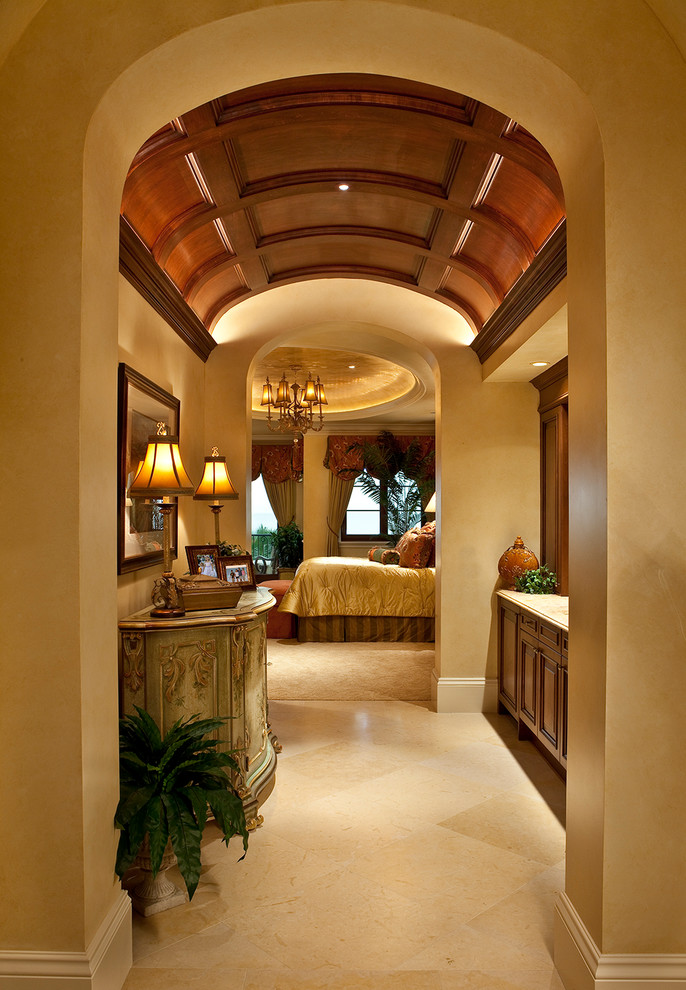
A barrel ceiling replaces a flat overhead plane with a continuous curve, giving hallways and passages a stronger architectural identity. The most effective barrel ceiling ideas use that curve to improve movement, lighting, and proportion rather than adding ornament simply because the shape feels unusual.
In narrow transitional areas, the curved form can make the journey between rooms feel deliberate.
Use the Curve to Emphasize Direction
Barrel ceilings naturally guide the eye forward. That makes them especially effective in entry passages, galleries, long hallways, and connections between major rooms.
A smooth uninterrupted curve usually feels longer and cleaner than one divided by too many decorative elements. If the hallway is short, a more pronounced arch can create a sense of enclosure without needing extra wall ornament.
Browsing interior architecture ideas can help when studying how ceiling shapes influence movement through narrow spaces.
Choose a Finish That Supports the Form
Painted drywall or plaster keeps attention on the geometry itself. This approach works well in contemporary homes or anywhere the curved ceiling needs to remain quiet.
Brick, wood, tile, or decorative plaster can make the vault more prominent. These materials work best when there’s a clear visual relationship with floors, doorways, or nearby architectural finishes.
Designers comparing stronger architectural focal points may also find decorative home references useful for thinking about how one feature can dominate a space without making every surface equally dramatic.
| Barrel Treatment | Visual Character | Suitable Space |
|---|---|---|
| Smooth painted plaster | Clean and continuous | Modern hallway |
| Wood lining | Warm and directional | Transitional passage |
| Brick surface | Strong texture | Rustic interior |
| Soft indirect lighting | Gentle depth | Entry corridor |
Use Lighting to Reveal the Curve
Light can make a barrel ceiling far more noticeable without adding physical decoration. Wall washing creates gradual highlights, while concealed lighting at the spring line can emphasize where the curve begins.
Small downlights can also work, but spacing needs care. A random row of fixtures may interrupt the flow of an otherwise smooth vault.
Looking beyond interior rooms to architectural design references can provide additional examples of how repeated arches and curved forms create rhythm across a building.
Frame the Beginning and End
A barrel ceiling becomes stronger when its boundaries are clear. Doorways, columns, wall returns, beams, or changes in flooring can identify where the curved passage starts and finishes.
This doesn’t mean both ends must look identical. One end might open into a living room while the other meets an entry hall. What matters is that the ceiling transition doesn’t feel accidental.
Keep Wall Details Under Control
Because the ceiling already creates movement, heavily decorated walls can make a narrow passage feel crowded. Simple artwork, shallow trim, or carefully spaced sconces often provide enough interest.
Where Barrel Ceilings Can Lose Their Impact
Adding too many competing elements is the easiest way to weaken a barrel ceiling. Multiple ceiling colors, oversized chandeliers, dense wall molding, elaborate flooring, and strong patterns can turn a graceful curve into visual noise.
Scale creates another risk. A deep curve over a narrow, low passage may feel compressed instead of elegant. The radius should fit the available width and height, leaving enough openness for comfortable movement.
Frequently Asked Questions
Are barrel ceilings suitable only for large homes?
No. A modest curved section can work in a smaller hallway if the proportions are controlled. Shallow curves and simple finishes usually suit compact passages better than heavily decorated vaults.
What lighting works well with a barrel ceiling?
Wall sconces, concealed linear lighting, small recessed fixtures, and carefully positioned pendants can all work. Lighting that grazes the curved surface is especially effective at showing its shape.
Can a barrel ceiling be used in a short hallway?
Yes. In a short passage, the curve can create a distinctive transition between rooms. Keeping the finish simple prevents the feature from feeling crowded.
Let the Curve Define the Passage
A barrel ceiling works best when its shape remains easy to read from one end of the passage to the other. Choose a radius that fits the available height, simplify surrounding finishes, and position lighting to reveal rather than interrupt the curve. With those decisions handled carefully, an ordinary hallway can become a memorable architectural connection between rooms.
